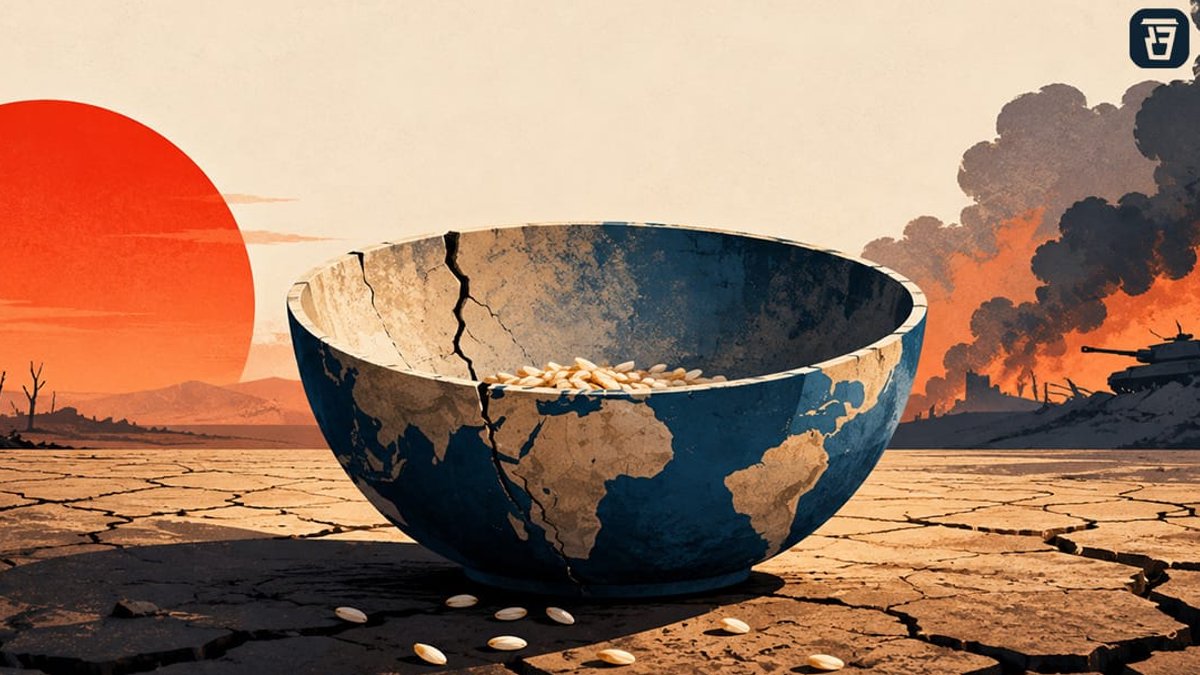
Global food prices are climbing despite record harvests in some regions, pointing to a crisis driven by deeper issues beyond simple shortages. Sugar, wheat, and rice costs have increased in recent months, even though cereal production reached a peak in 2026. The gap between supply and prices stems from transport disruptions, fertiliser shortages, and financial constraints that strain supply chains more than crop yields alone.
This situation has become a central topic in global discussions, with External Affairs Minister S. Jaishankar describing it as a 4F crisis—food, fuel, fertiliser, and finance—for developing nations. His assessment aligns with visible trends in global markets. The FAO Food Price Index, which monitors international prices for cereals, sugar, meat, dairy, and vegetable oils, reached 136 points in September 2026, marking a 5.8% rise from the previous year. Cereal prices alone surged 17.2% over the past twelve months, with wheat hitting its highest level since August 2023.
However, production figures tell a different story. The FAO projects 2.9 billion tonnes of global cereal output in 2026, just 2.1% below the 2025 record. If supply is not the core issue, then what explains the price spikes?
Transport and fertiliser shortages create the bottleneck
Shipping challenges play a major role. Ukraine, a key exporter of wheat and maize, depends on the Black Sea for global trade routes. Disruptions in the region have pushed wheat prices up 6.3% in September, despite abundant crops elsewhere. The problem extends beyond grains. Fertiliser production is concentrated in a few countries, Russia, China, Morocco, and Persian Gulf states, making the sector highly vulnerable to disruptions.
When the Strait of Hormuz faced instability in 2026, global seaborne fertiliser trade was at risk, with up to one-third of shipments potentially affected. Nitrogen fertilisers like urea and ammonia rely on natural gas, both as a raw material and energy source. Fluctuations in gas prices directly raise fertiliser costs, and farmers feel the impact months later when yields decline. A disruption in 2026 could still reduce harvests in 2027.
Adding to the strain, countries with fertiliser supplies are restricting exports. China and Russia have introduced quotas, duties, and licensing requirements to prioritise domestic agriculture. The WTO estimates these measures now cover 15% to 23% of global fertiliser exports, depending on how Persian Gulf shipments are counted. For nations reliant on imports, this means higher costs and scarcer availability.
Financial pressures worsen the crisis
Currency fluctuations further deepen the affordability crisis. Most food, fuel, and fertiliser trade is priced in US dollars. During geopolitical instability, capital shifts to safer assets, weakening currencies in developing economies. Even if global commodity prices remain stable, dollar-denominated imports become more expensive for these nations.
Climate change adds another layer of uncertainty. The NOAA’s September 2026 report indicated a 90% chance of a very strong El Niño developing during the 2026–27 winter, with a 75% probability of historically intense conditions between October and December. While El Niño does not cause drought everywhere, regions like Southern Africa, South and Southeast Asia, and Central America are particularly at risk. The FAO has already identified these areas as highly vulnerable.
India, for now, remains relatively protected. Its 2025–26 foodgrain production is projected at 376 million tonnes, including record outputs of rice, wheat, and maize. The government’s subsidised foodgrain program covers 810 million people, acting as a buffer against global price fluctuations. However, the country is not entirely shielded from broader risks.
India still imports liquefied natural gas and fertiliser. When disruptions in the Persian Gulf cut off supplies, domestic agencies sought alternatives, China, Egypt, Vietnam, and Russia. Nitrogen fertiliser imports rose 52% in the first half of 2026, adding 1.1 million tonnes to the total. While grain reserves remain stable for now, future production depends on inputs that remain tied to global markets.





Leave a Reply